
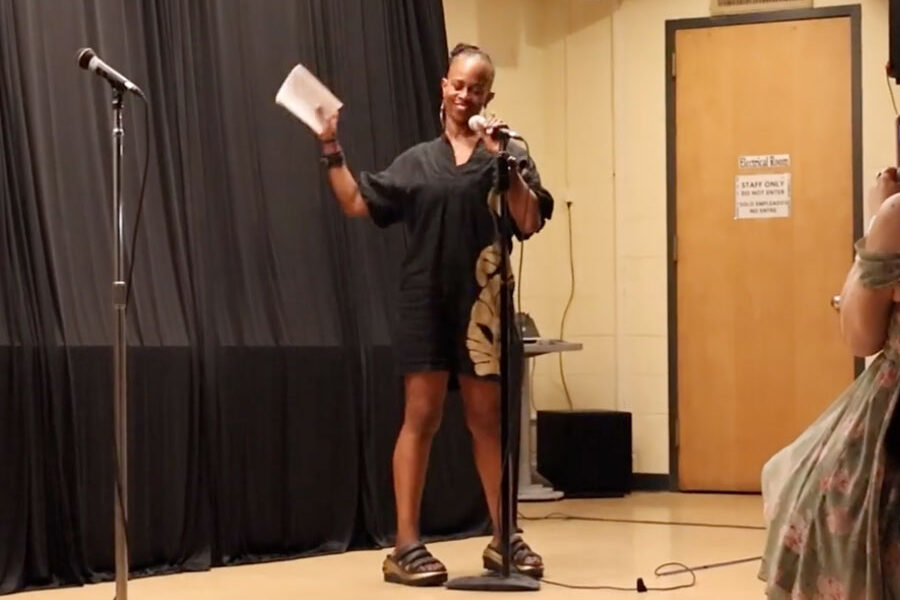
From Rock Bottom to Rebirth: Lateefah’s Story
At the StorySlam Performance on June 25 at Johnson Public Library, CMDE Artistic Director Lateefah Fleming shares a deeply personal story of courage, struggle, and transformation.
After leaving everything behind to start a new life in Mexico, Lateefah found herself confronting depression, anxiety, and a profound sense of failure when she returned to the United States. With the support of family, friends, meditation, and professional help, she began a new chapter—one rooted in self-acceptance, gratitude, and purpose.
Her story is a powerful reminder that sometimes our lowest moments can become the beginning of a new life.
“I am a survivor. I am a Thriver. And I am Lateefah.”

From Flute to FOMO: Corinne Finds Her Way Back to Dance
What happens when a little girl dreams of becoming a singing, dancing, visionary astronaut? Eventually, she may just find her way to CMDE!
At the StorySlam Performance on June 25 at Johnson Public Library, CMDE Director Corinne shares her personal journey with dance—from sparkly costumes and dancing with her family, dog, and anyone willing to join, to middle-school “ugly duckling” years, competitive dance, marching band, and eventually finding her way back to movement.
After discovering CMDE while looking for a career that combined creativity and helping others, Corinne joined the organization as Youth Program Coordinator. Watching dancers in the studio eventually gave her a serious case of FOMO, and she decided to step back onto the dance floor herself.
Encouraged to try West African Dance, Corinne discovered that it was okay to make mistakes, learn something new, and simply enjoy moving. Her story is a joyful reminder that you don’t have to be a professional dancer—or even get every step right—to belong on the dance floor.
Sometimes you just have to put down the flute, embrace the FOMO, and dance!
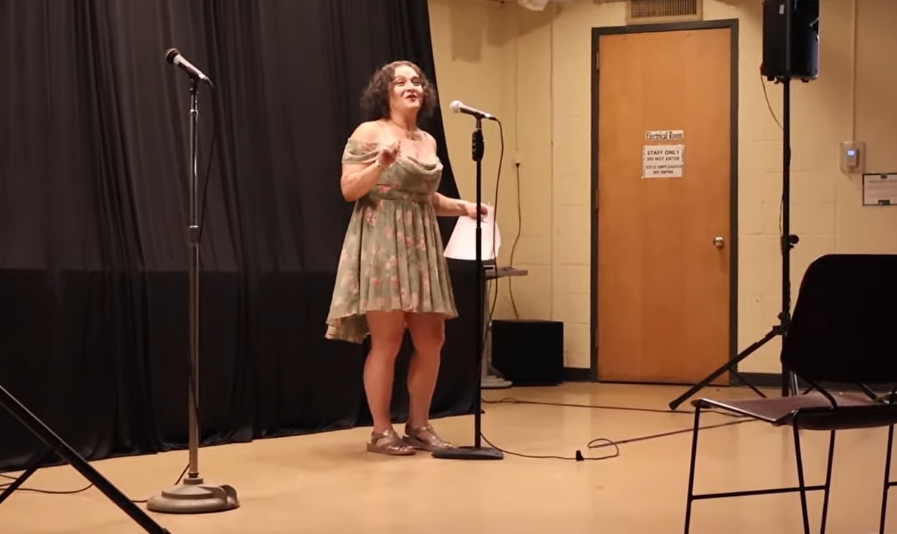
Tatiana’s Story: The Dance Back to Life
At the StorySlam Performance held on June 25 at Johnson Public Library, Tatiana, a participant in the Hackensack Moves Dance Company, shared a powerful, deeply personal—and occasionally hilarious—story about resilience, movement, and finding her way back to joy.
Tatiana begins her story with the remarkable odds of simply being here at all: as a descendant of survivors of the Armenian genocide and as a child whose own path into the world was far from ordinary, she describes herself as someone who has been moving against the odds from the very beginning. Through sports, dance, and her passion for standing up to injustice, movement has always been part of who she is.
But in May 2024, everything stopped.
After experiencing burnout, heartbreak, and a deep emotional breakdown, Tatiana spent months withdrawn from the world and disconnected from the movement she had always loved. Eventually, a series of health diagnoses gave her another challenge to face. But Tatiana, as she tells it, decided she was “bored with depression” and started looking for a way back.
That way was movement—one tiny step at a time.
At first, even a three-minute walk felt overwhelming. But she kept going. She walked, researched, rested, moved, and gradually rebuilt her strength. Along the way, she discovered a local wellness center and signed up for everything—including yoga, Pilates, Tai Chi, and classes led by the fabulous Miss Lateefah.
Then came an unexpected opportunity: Hackensack Moves Dance Company was forming at CMDE, and auditions were being held.
Tatiana didn’t think she had a chance.
She auditioned anyway.
And she got in, y’all!
Just months after struggling to walk for three minutes, Tatiana was back on stage, performing five dances in one night—African dance, modern dance, ballet, and belly dance—with the Hackensack Moves Dance Company. And because apparently five dances were not enough dancing for one evening, she continued celebrating and dancing until 2:00 in the morning.
Yes, she ended up in the ER with severe muscle cramps.
But as Tatiana points out, the paramedic told her they usually see that kind of condition in marathon runners.
Not bad for someone who could barely walk three minutes just seven months earlier.
Today, Tatiana continues to dance wherever life takes her—including the aisles of ShopRite, where the self-checkout machines are apparently quite familiar with “the dancing girl.” She has found strength, joy, community, and a renewed connection with herself through movement.
Her story is a beautiful reminder that healing is rarely graceful, predictable, or perfectly choreographed. Sometimes you take one step. Sometimes you fall down. Sometimes you end up dancing until 2:00 AM and discover that your enthusiasm has exceeded your muscle capacity.
But you keep moving.
For Tatiana, movement did more than change her routine. It helped her find her way back to herself.
Watch Tatiana’s full StorySlam performance and discover why, sometimes, the most powerful thing we can do is simply take the next step—and then maybe dance a little. 💃✨

Remembering Ursula Pelle
It is with deep sadness that we share the news of the passing of Ursula Pelle, a beloved trustee, educator, and advocate for the arts.
Ursula’s presence at CMDE was a quiet yet profound force, and her dedication to our community left an indelible mark on all who had the privilege of knowing her.
For over 17 years, Ursula served as a trustee for CMDE, bringing her thoughtful perspective, unwavering commitment, and deep passion for music and the arts. Though she may have been shy at times, her advocacy was anything but quiet. Whether through her involvement in CMDE’s dancercise classes or her participation in our open houses, where she embraced new experiences with an adventurous spirit; Ursula embodied the spirit of lifelong learning and curiosity.
As a music educator, Ursula touched countless lives with her intelligence, kindness, and generosity. Ursula wore many hats. She was a mother, a mime, a grandmother, and a character in the truest sense; a woman of depth and warmth who brought joy and laughter wherever she went. Her dedication extended beyond CMDE; she was also a board member of a mime-accompanying school, a testament to her belief in the universal language of performance and expression.
One of the many things that made Ursula special was her thoughtfulness. She remembered to bring cards for every special occasion, a small but meaningful gesture that reflected her care and attention to the people around her. Whether it was a milestone, a celebration, or simply a moment of connection, Ursula’s presence was a gift.
To her family, especially her daughter Laura, with whom she shared a love for modern dance, we extend our deepest condolences.
Let us honor her memory by carrying forward the light she brought into every room she entered. Ursula’s legacy reminds us that the arts are not just about performance; they are about connection, about the quiet moments of joy, and about the courage to try new things. Whether through a dance class, a mime performance, or a simple card on a special day, she showed us how to live with intention, kindness, and a deep love for the world around us.
Send your stories/memories of dancing with Ursula to info@cmde.org

Remembering Ruth Bauer Neustadter
We honor and remember Hackensack’s own artistic legend, and CMDE Board Member, Ruth Bauer Neustadter.
Ruth was a visionary mixed-media artist, a passionate dancer, choreographer, and a tireless champion for local arts. She was instrumental in founding the art gallery at HACPAC, which now proudly bears her name.
Ruth’s legacy is permanently woven into the fabric of our community. We send our deepest condolences to her family, friends, and everyone who has been touched by her brilliance.
Ruth was a special education teacher at East Side High School in Newark for many years. Ruth advocated fiercely for her students, supporting disability education and rights and developing lifelong meaningful relationships with her students. Ruth followed her moral compass and rallied for climate change, social justice, antiwar efforts, and children’s rights all over the world.
In a world full of conformists and copycats, Ruth paved her own way and encouraged the community to join her through every journey. Where some saw garbage, Ruth saw art, meaning, and value. May we all remember the wonderful and beautiful life and work of Ruth Bauer Neustadter. Ruth’s legacy lives on in the lives she touched, the arts she championed, and the community she nurtured.
Let us honor her memory by continuing her work: by fostering inclusivity, embracing creativity, dancing, and supporting one another with the same compassion and dedication she showed us all.
Send your stories/memories of dancing with Ruth to info@cmde.org

Circa early 50s. From the left: Unknown, Judy Schwartz (Shirley’s best friend and early Studio teacher), Ruth Bauer Neustadter, Mimi (her sister), unknown, Shirley Ubell. The Ubell’s residency in Paramus.
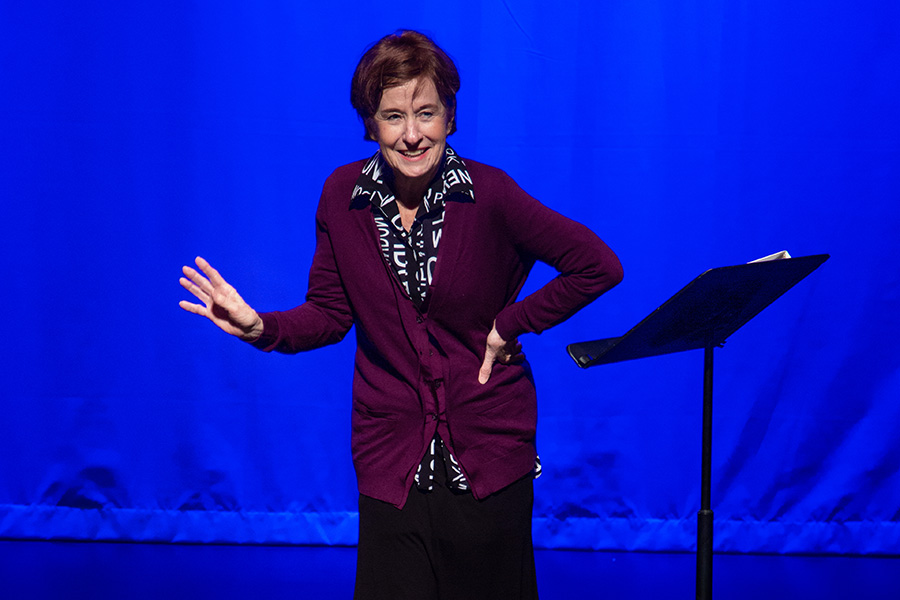
Claire Porter – means to carry light
by Corinne Reilly-Ferretto
What brought you to CMDE?
I studied at La Mont institute in Manhattan and came to CMDE to see a performance with a friend at the Studio in ‘1980-something.’ I have been connected to CMDE one way or another since.
When did you start dancing?
As I was growing up, I danced ballet, tap, point work, and got accepted to a Starlit group in high school where I sang and danced. Although I loved dance, I moved my focus elsewhere for a while. At 17, I declared my major in college, a subject that was easy for me—math. I also played tennis and golf. At the time I considered myself very sporty. I graduated and became a computer programmer, working for GE.”
What brought you back to dance?
One night, I was invited to see a performance of Maria Tallchief, a Native American ballet dancer from the southwest. I was so moved by the performance, I wept. The next day I went to a dance studio and reignited my love for dance. Soon after, I found my way to California, working for a software company outside of San Francisco. I met Marsha, a dance artist at Sonoma State University who invited me into the world of Modern Dance. I took my first modern dance class. I was floored. Modern dance had everything! It was philosophical, physical, spiritual, psychological, it was art, it was expression.”
From there, I started dancing and dancing, and, after that, I started making dances, group dances in unison that were a lot of fun. I danced everything. There were little dance companies sprinkled all over that I became a part of. I danced at schools, on stage, anywhere that wanted dancers.
I applied to Ohio State, where I received a scholarship for graduate work, so I went there! I was a graduate assistant; I taught and danced. I was dancing nonstop. I worked with people from Graham to Merce Cunningham. I took lots of workshops, tried out different dances, and met wonderful people.
Towards the end of my graduate school journey, I took a class based on Rudolf Laban. I was so enamored by the clarity of the work, I decided to immerse myself in the work at Sonoma State in California and then Grand Valley College in Michigan. Afterwards I began teaching movement and analysis and got funding from Grand Valley College to study dance in London in 1981.
What is Laban Movement & Analysis?
I got certified in the Laban Movement & Analysis which is an intensive program. This program took a little over two years to complete, and then I was certified! Laban Movement & Analysis focused on the body and integration of the breath, It provided a theoretical and experiential system for observation and focused on body connectedness, performance, and interpretations of human movement. Laban was prolific and created many projects and schools all over the world.
What were some memorable events in your career so far?
When I was working at Muhlenberg College in Pennsylvania, Charlie Rose, a famous interviewer from PBS 13, talked with me after a great performance. I remember smiling from ear to ear during and after the interview, but I have no idea what I said.
Another highlight was being asked to perform at the Baryshnikov Arts Center for its grand opening in New York in 2005.
From there, I moved to Teaneck, NJ, where I applied for and got a NJ Council of Arts Grant. It was an impactful moment of “okay I live here, I’m appreciated here.” It inspired me to explore dancing in New Jersey even more.
How has your dancing changed over the years?
I experienced a shift in my artistic attention. I started writing scripts. I started getting involved with language and movement. I formed writing groups and directed rehearsal projects. These included what I called “Grammar dances.” I also invented “Portables”—solo and group work to take anywhere. Admittedly, I flipped to language because I was so physically tired from all the dance I had been doing. I decided to do something with words and gestures instead. The new work was so cool that I made more! “Planted Feet” was my first big gesture and spoken word Portable. Next, I decided to make a new piece at Grand Valley and then a piece called “Portable Lecture” about the gestures of teaching in a lecture hall. I did this by sitting all the way in the back of the class, watching the professors and noting their gestures as they facilitated classes. Their combined speaking and choreographing seemed like music. I also watched the change in the audience during these “performances,” and it changed me. It broke through the “fourth wall.” I saw the people all the way in the back leaning forward, so then I leaned forward. And there was this connection. There was no going back after that.
Where do you see the future of your dance and career going?
Getting Covid knocked me out of dance for a while, but I made my recovery and continued my movements and analysis. My interests are branching out more; researching creativity itself. Currently I teach at Montclair and FDU, and have previously taught at Columbia, Raritan Valley, Ohio University, Connecticut College, and NYU.
One interest leads to another. A new project I’m working on is writing a play, “Train of Thought,” about five women on a train. I’ve put together choreography for other dance companies and continue to make new work for groups and solos.
Where do you see the future of dance?
We love to dance; we’re always going to be dancing. As for Modern Dance, it has morphed; it has become so gymnastic and flamboyant. It was based on psychology, feelings, expression, but I think it imploded. It was about the internal dancer’s world, but the audience wanted it to be about them. So it has changed and will keep changing”. I did a piece called “Modern on Modern” which was about “What is Modern Dance?” for the 50th anniversary CMDE. Each dancer answered the question individually and both spoke and danced the response.
SHARE